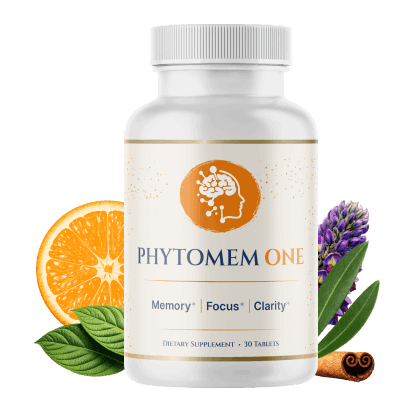
Phytomem One Review — A Ten-Ingredient Brain Supplement With No Published Doses (November 2026)
Disclosure: This article may contain affiliate links. If you purchase through these links, the publisher may receive compensation at no extra cost to you. This is not medical advice. Statements about dietary supplements have not been evaluated by the FDA. Consult a healthcare professional before starting any supplement.
The Short Version
Phytomem One does several things better than most supplements in this category. It names all ten of its ingredients individually rather than hiding them behind an unnamed proprietary blend. It builds its formula around a coherent thesis — that metabolic health and cognitive health are connected — rather than a random assortment of “brain herbs.” It is stimulant-free, so it will not disrupt sleep or stack badly with your morning coffee. And its 60-day refund runs through ClickBank, which is the enforceable kind.
Its limitation is real and specific: it publishes no milligram amounts for any ingredient, so you cannot check whether the formula matches the research that makes those ingredients interesting. If the company fixes that one thing, this becomes a substantially better product.
What It Gets Right
Full ingredient naming. The formula lists ten ingredients in three labeled groups — a Cellular Defense Matrix (saffron, fucoxanthin, fucoidan, oleuropein), a Brain Fuel & Vitality Complex (berberine, Ceylon cinnamon, corosolic acid, kudzu flower), and a Neural Amplifier System (Morosil, xylitol). Many competitors in this space print a single “proprietary cognitive blend” and name nothing. Phytomem One tells you what is in it.
A genuine evidence anchor. Saffron is the standout. A pooled analysis of five randomized trials in 325 participants found saffron outperformed placebo on cognitive scales. That evidence is in people with mild cognitive impairment or Alzheimer’s, not healthy adults, and the authors flag a high risk of bias — but it is real human data on a real ingredient, which is more than most memory supplements can point to.
A coherent metabolic thesis. The berberine, Ceylon cinnamon, banaba, and Morosil half of the formula is not random. Berberine and cinnamon carry strong meta-analysis support for glucose control, and research genuinely links metabolic health with cognitive health. Whatever else is true, the formula is aimed at a real physiological lever.
Ceylon cinnamon specifically. The formula uses Ceylon rather than cassia, which is the better choice — cassia contains far more coumarin, a compound that can stress the liver at high intake. That is a considered formulation detail.
No stimulants. No caffeine, no racetams, no synthetic stimulants. For anyone who has had a bad experience with stimulant-based focus products — jitteriness, afternoon crashes, disrupted sleep — that matters.
One tablet daily. Simple enough to actually maintain. A single tablet with food is easier to stick with than a multi-capsule stack, and adherence is where most supplements succeed or fail.
An enforceable refund. The 60-day guarantee runs through ClickBank, not just the vendor. If the seller stalls, ClickBank support with your order number is the route that does not depend on the vendor answering email. That is a structural advantage over seller-only promises.
A trial window that fits the evidence timeline. The two best-known saffron trials ran for 16 and 22 weeks. The two-bottle pack covers 60 days — short of the trial duration, but long enough to judge tolerance and early subjective change, and the refund window lets you exit if it does not suit you.

What to Know Before Buying
The doses are not published. All ten ingredients are named without milligram amounts. That means you cannot compare the formula to the saffron trial dose, the berberine meta-analysis dose, or anything else. The company frames its approach as “individually itemized” labeling — which is accurate, but naming an ingredient is not the same as dosing it. Ask the seller for the Supplement Facts panel before ordering. If they provide it, you can make a genuinely informed decision.
The “toxic brain shards” marketing overshoots. The sales videos lean on a microplastics study from the University of New Mexico. The study is real and interesting — it found plastic fragments in brain tissue, more in 2025 samples than 2016, and more in people with dementia. But it measured plastic, not memory. It found an association, not a cause. And it did not test any intervention. The metabolic-brain angle is the stronger story, and it is the one the ingredient list actually supports.
The review count is self-hosted. The page cites 4.8 stars across tens of thousands of reviews, but those live on the company’s own platform rather than an independent aggregator. Independent review sites range from 2.6/5 to 4.6/5 — a spread that tells you the evidence does not settle the question for everyone.
Minimum spend is $158. There is no single-bottle option. The two-bottle pack is the entry point, and it runs out roughly as the refund window closes — so plan your evaluation accordingly.
Clear the interactions first. Berberine interacts with diabetes medication and several other drug classes and is not appropriate during pregnancy or breastfeeding. Kelp-derived ingredients contribute iodine, which matters if you have a thyroid condition. Xylitol is toxic to dogs. None of these is exotic, but each is worth a pharmacist conversation before you start.
Who This Is a Good Fit For
- Adults over 45 noticing word-finding pauses who want a stimulant-free option
- People whose blood work shows borderline fasting glucose or A1c and who want a formula that addresses metabolic health alongside brain health
- Anyone who cannot tolerate stimulant-based focus products
- People who prefer one small tablet to a multi-capsule ritual
- Buyers who want a processor-backed refund and will use the 60-day window as a structured trial
Who Should Look Elsewhere
- Anyone who needs published milligram doses before buying
- People taking metformin, insulin, or another glucose-lowering medication without prescriber clearance
- Anyone with a thyroid condition without checking the kelp-derived iodine with a doctor
- People hoping to test one bottle cheaply — the minimum is two bottles at $158
- Anyone with new, worsening, or functionally interfering memory problems — those need a medical workup, not a supplement
The Verdict
Phytomem One is a thoughtfully assembled formula with one real evidence anchor and one significant transparency gap. The saffron data is genuine, the metabolic thesis is coherent, the cinnamon choice is considered, the format is convenient, and the refund is enforceable. Those are meaningful strengths, and they put it ahead of most of what circulates in the memory-supplement category.
The gap is dose disclosure. A formula this well-conceived deserves a published panel — and until it has one, the honest position is that you are buying a plausible formula on trust rather than a verified one.
Buy it if you want a stimulant-free metabolic-and-antioxidant tablet, you have cleared berberine and iodine with a clinician, you will ask the seller for the Supplement Facts panel first, you will buy only through the official ClickBank checkout, and you will treat the 60 days as a documented personal experiment.
Skip it if you need published doses, you take interacting medication without clearance — or you are buying it for the microplastics story, because that is not what the formula actually does.
This article is for informational purposes only and is not medical advice. Statements about dietary supplements have not been evaluated by the FDA. Consult a healthcare professional before starting any supplement.
Editor’s notes: (1) Confirm or remove the author byline — do not use “Dr./MD” unless verified. (2) This is a positively framed review, not a testimonial — do not relabel it as customer feedback or add invented user quotes. (3) The dose disclosure gap must remain in the final copy; presenting the formula as fully transparent would be inaccurate. (4) The berberine interaction and kelp-iodine cautions are the relevant safety disclosures. (5) The self-hosted review count should be attributed as a seller claim, not presented as an independent rating. (6) Verify current pricing and the 60-day-from-delivery refund terms at checkout before publishing.