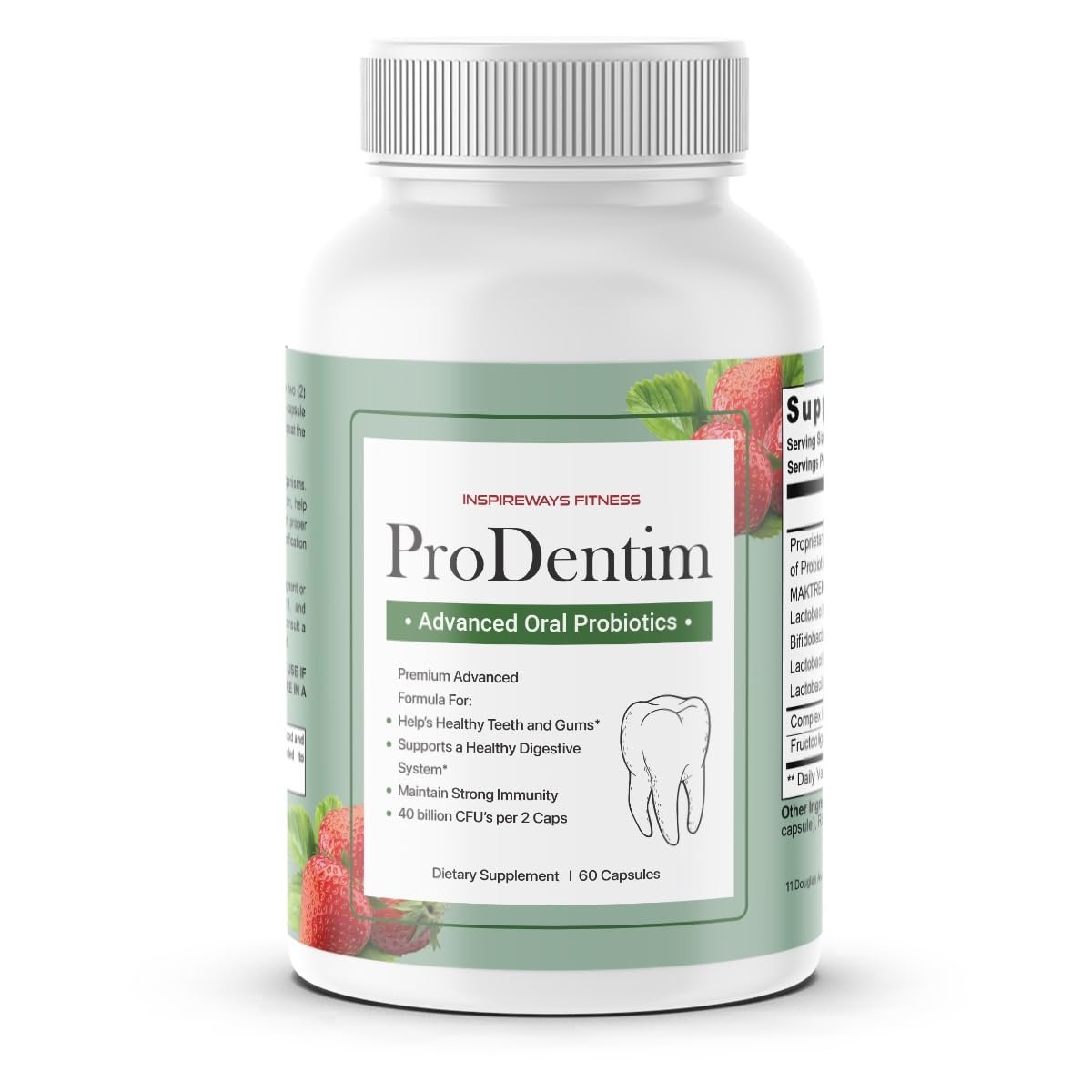
ProDentim Review — An Oral Probiotic Whose Label and Marketing Don’t Match (November 2026)
Disclosure: This article may contain affiliate links. If you purchase through these links, the publisher may receive compensation at no extra cost to you. This is not medical advice. Statements about dietary supplements have not been evaluated by the FDA. Consult a healthcare professional before starting any supplement.
Overview
ProDentim is a once-daily chewable probiotic tablet marketed for gum health, fresh breath, and oral microbiome balance. Each bottle holds 30 tablets — a 30-day supply — and the directions are to chew one tablet slowly each morning, ideally after brushing, and let it dissolve in the mouth rather than swallowing it whole.
The formula is built around a probiotic blend supplying 3.5 billion CFU at manufacture, alongside inulin (a prebiotic fiber), malic acid, tricalcium phosphate, and peppermint. The NIH label names three strains: L. paracasei, L. reuteri, and B. lactis BL-04.
ProDentim is sold exclusively through its official website, with ClickBank appearing as the retailer on your card statement and handling refunds. Pricing runs from $69 for one bottle** down to **$49 per bottle at six bottles, with free US shipping. A 60-day money-back guarantee is stated.
The two central problems are label inconsistency and missing per-strain doses. The strain count changes depending on which page you read. The CFU split across strains is never published. And the finished formula has never been tested in an independent clinical trial.
What’s in It
What’s disclosed: the names of three probiotic strains and four supporting ingredients; the total CFU count (3.5 billion); the blend weight (20 mg).
What’s not disclosed: the CFU count per individual strain. Clinical oral probiotic research typically uses 10⁸ to 10¹⁰ CFU per strain, and without per-strain numbers, the blend cannot be directly compared to those trials.
A note on the strain count: the NIH label lists three strains. Several sales pages and affiliate reviews list five, adding BLIS K12 and L. salivarius. A buyer cannot know which formula they are receiving without reading the bottle, not the website.

How It’s Positioned to Work
The marketing describes a microbiome-balance mechanism: beneficial Lactobacillus strains colonize the mouth, produce antimicrobial compounds, and outcompete cavity-causing bacteria like Streptococcus mutans, supporting gum tissue and fresher breath.
Where the ingredient evidence is genuinely supportive:
L. reuteri is the strongest element in the formula. It produces reuterin, an antimicrobial compound that inhibits several harmful bacteria, and multiple trials report reduced gum bleeding and modest improvements in gum attachment when it is used alongside conventional periodontal care. L. paracasei also has consistent evidence across seven studies.
Where the marketing outruns the evidence:
The sales page’s whitening, cavity-prevention, and “rebuilds gum health” claims are not supported by independent trials of the finished ProDentim formula. One clinical review puts it plainly: the ingredient concept has merit, but the product’s specific efficacy claims exceed the available evidence.
A critical strain mismatch: the headline periodontitis trial the sales page cites tested B. lactis HN019, not the BL-04 strain in the formula. That is not a minor detail — it means the study being used to sell the product does not test the strain the product contains.
What It May Be Good For
Gum sensitivity and occasional bleeding. This is the most defensible use case. L. reuteri has the strongest oral-health evidence of any strain in the formula, and the mechanism — reducing gum inflammation and bleeding — is supported by multiple clinical studies. One real-world six-week evaluation by an independent review team found reductions in bleeding on brushing by weeks 3–6 among adults with self-reported gum discomfort.
Breath freshness. The combination of peppermint and the displacement of volatile-sulfur-producing bacteria makes a mild freshening effect plausible, and it is the benefit most consistently reported anecdotally.
An easy daily routine. A chewable tablet that dissolves in the mouth is simple to incorporate after brushing, and the format delivers the probiotics directly to the oral cavity rather than through the digestive tract.
A real refund channel. The 60-day guarantee is processed through ClickBank, not the vendor alone. That is the enforceable kind — if the seller stalls, ClickBank support with your order number is the route that does not depend on the vendor answering email.
What to Keep Expectations Realistic About
Teeth whitening. Malic acid has some research interest, but whitening is not an established outcome for this formula, and independent reviewers flag the whitening claim as marketing overreach.
Cavity prevention. Some L. reuteri studies show reduced cavity-causing bacteria, but results on actual cavities are mixed.
Per-strain dosing. Without individual CFU counts, you cannot know whether the L. reuteri portion matches the amounts used in the gum-health trials.
Replacing dental care. Gum disease causes irreversible bone loss, and professional cleaning removes biofilm that no tablet can reach. ProDentim is positioned as support, not treatment.
The review record. Trustpilot rates the product 1.9/5 (“Poor”) across 101 reviews, with only three in the last 12 months, and Trustpilot notes the company “hasn’t invited customers, so reviews may not be representative”. Reviews describe ineffectiveness, refund obstruction, and adverse effects — including one reviewer who reported gas and diarrhea and no dental improvement, and another who reported low blood calcium after three weeks and white buildup on the tongue. A retired dentist wrote: “this product is an entire scam… Dental caries and periodontal disease is not cured by taking a supplement”. Some refunds were eventually issued after persistent contact.
A clean domain landscape. Third-party trust scores across ProDentim-branded sites have returned 0/100 on one domain with phishing flags and hidden WHOIS, and 66/100 on another described as “probably not a scam but legit.” The spread is the warning.
The “$109 bonus value.”** Two digital guides are listed with a stated retail value of **$109 each. That is the seller’s own figure, not a verified saving.
Who It Suits
- Adults with mild gum sensitivity or occasional bleeding who want an oral probiotic alongside brushing, flossing, and dental visits
- People interested in L. reuteri specifically, which has the strongest gum-health evidence in the formula
- Anyone who prefers a chewable tablet over capsules or powders
- Buyers who value a third-party refund channel and will use the 60-day window as a structured trial
- People who understand the formula is microbiome support, not a whitening or cavity-reversal treatment
Who Should Skip It
- Anyone with bleeding gums that persist beyond two weeks, loose teeth, pain, or swelling — these require a dentist, not a tablet
- Immunocompromised individuals — live probiotics carry a small risk profile, and one safety review notes that immunocompromised patients, those with central venous catheters, or recent major oral surgery should seek medical guidance due to rare bacteremia risk
- People who need per-strain CFU counts before purchasing
- Anyone expecting whitening or cavity prevention — the evidence does not support those claims for this formula
- Pregnant or nursing women, and anyone under 18, without medical clearance
- Shoppers who cannot confidently identify the official ClickBank checkout — marketplace listings void the guarantee and introduce authenticity risk
Practical Buying Notes
- Confirm the strain count on the bottle. The NIH label lists three strains; some sales pages list five. Do not rely on the website — the bottle is the only reliable record.
- Confirm the price tier at checkout. The disclosed ladder is $69 for one bottle, $59 per bottle for three ($177 total), and $49 per bottle for six ($294 total)**, with **free US shipping**. One review cites a **two-bottle entry pack at $158 plus $9.99 shipping — confirm the actual tier at checkout.
- Read the refund terms. The 60-day window counts from purchase, and the guarantee is administered through ClickBank, not the vendor. Keep the confirmation email and screenshot the checkout page.
- Buy only through the official checkout. Marketplace and mirror-site listings are not covered by the 60-day guarantee and carry counterfeit risk.
- Let the tablet dissolve fully for maximum contact with the oral cavity, rather than chewing and swallowing immediately.
- Do not stack with antibiotics or antimicrobial supplements — live probiotics can be rendered ineffective by strong antimicrobials, including high-dose oregano oil or berberine.
Bottom Line
ProDentim is a real oral probiotic with one genuinely interesting ingredient and a label that does not match its own marketing. Lactobacillus reuteri has the strongest evidence for gum health of any strain in the formula, with a 17-RCT meta-analysis behind it, and the ClickBank refund is genuinely enforceable. Those are real strengths.
Its limitations are the ones that define the oral-probiotic category. The label lists three strains while the marketing describes five, the per-strain CFU counts are hidden, the cited periodontitis trial tested a different strain than the one in the bottle, and the finished formula has no independent clinical trial. The whitening and cavity-prevention claims outrun the science, and the Trustpilot record is 1.9/5 with repeated accounts of ineffectiveness, refund friction, and adverse effects. Independent reviewers score it anywhere from 3.9/5 (an editorial score explicitly “not based on a proven cure”) to 4.9/10 from a dose audit that found the label and the sales page describe different products.
Buy it only if you want an oral probiotic for mild gum sensitivity or breath freshness, you accept that L. reuteri is the formula’s strongest element and the evidence is ingredient-level, not product-level, you will read the bottle label rather than the website, and you will purchase through the official ClickBank checkout so the refund applies. Skip it if you need per-strain dosing, you are looking for whitening or cavity prevention, you are immunocompromised — or you have persistent bleeding, loose teeth, or pain, because those require a dentist, and a chewable probiotic cannot treat periodontal disease.
This article is for informational purposes only and is not medical advice. Statements about dietary supplements have not been evaluated by the FDA. Consult a healthcare professional before starting any supplement.
Editor’s notes: (1) Confirm or remove the author byline — do not use “Dr./MD” unless verified. (2) The label-versus-marketing strain count discrepancy — three strains on the NIH label, five on some sales pages — is the central factual point and must remain in the final copy. (3) The B. lactis BL-04 strain mismatch (the cited trial tested HN019, not BL-04) is the second critical point and should not be softened. (4) The Trustpilot 1.9/5 with only three reviews in 12 months is the key independent evidence point — present it with the caveat that Trustpilot notes the sample “may not be representative.” (5) The per-strain CFU counts are not disclosed — do not present the 3.5 billion total as a per-strain dose. (6) The immunocompromise caution and the antibiotic/antimicrobial interaction are the relevant safety disclosures. (7) All external domain references and links have been removed — no third-party site, refund portal, or trust-score domain is named. (8) Do not add testimonials or efficacy claims beyond what is attributed here, and do not repeat the “five-strain” marketing description as fact.